Connect with Contacts
Elevate your client management with Edda's smart CRM, capturing every opportunity for the modern investor.
Investors in 40 countries manage $300B in assets on Edda








Contact management with the modern investor in mind
Automate contact management
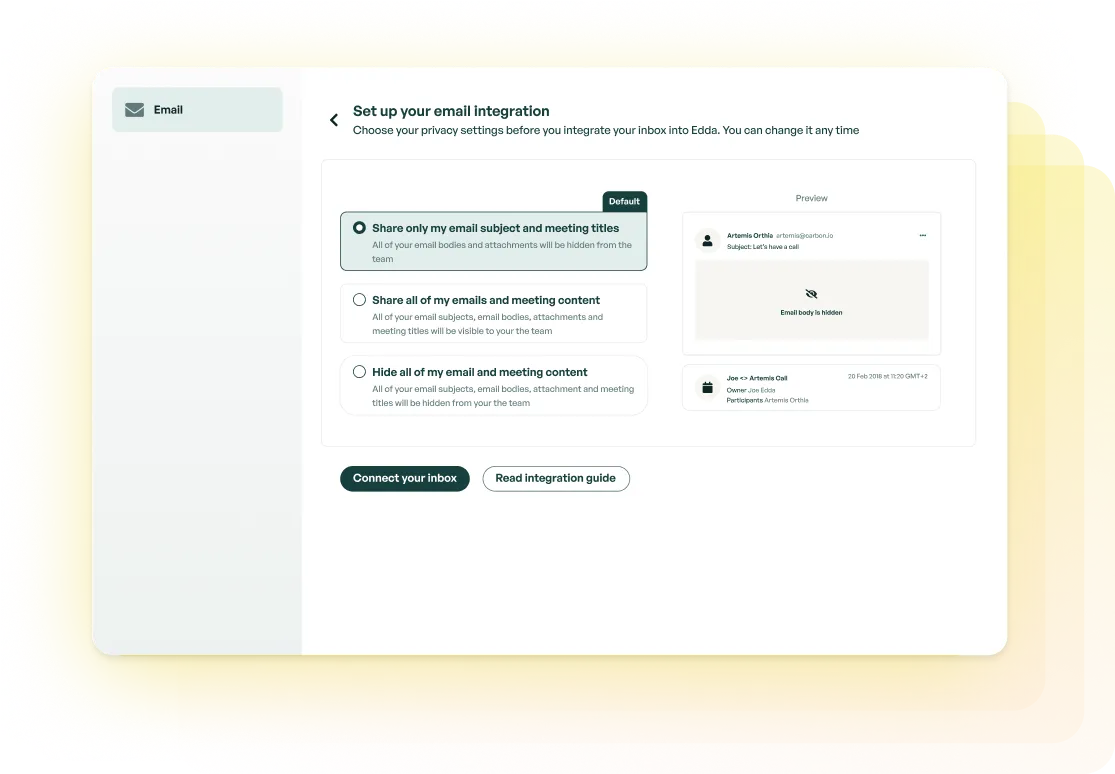
Edda’s contact management automation saves hours of manual work and eliminates errors with precise contact updates.
Go deeper with custom fields
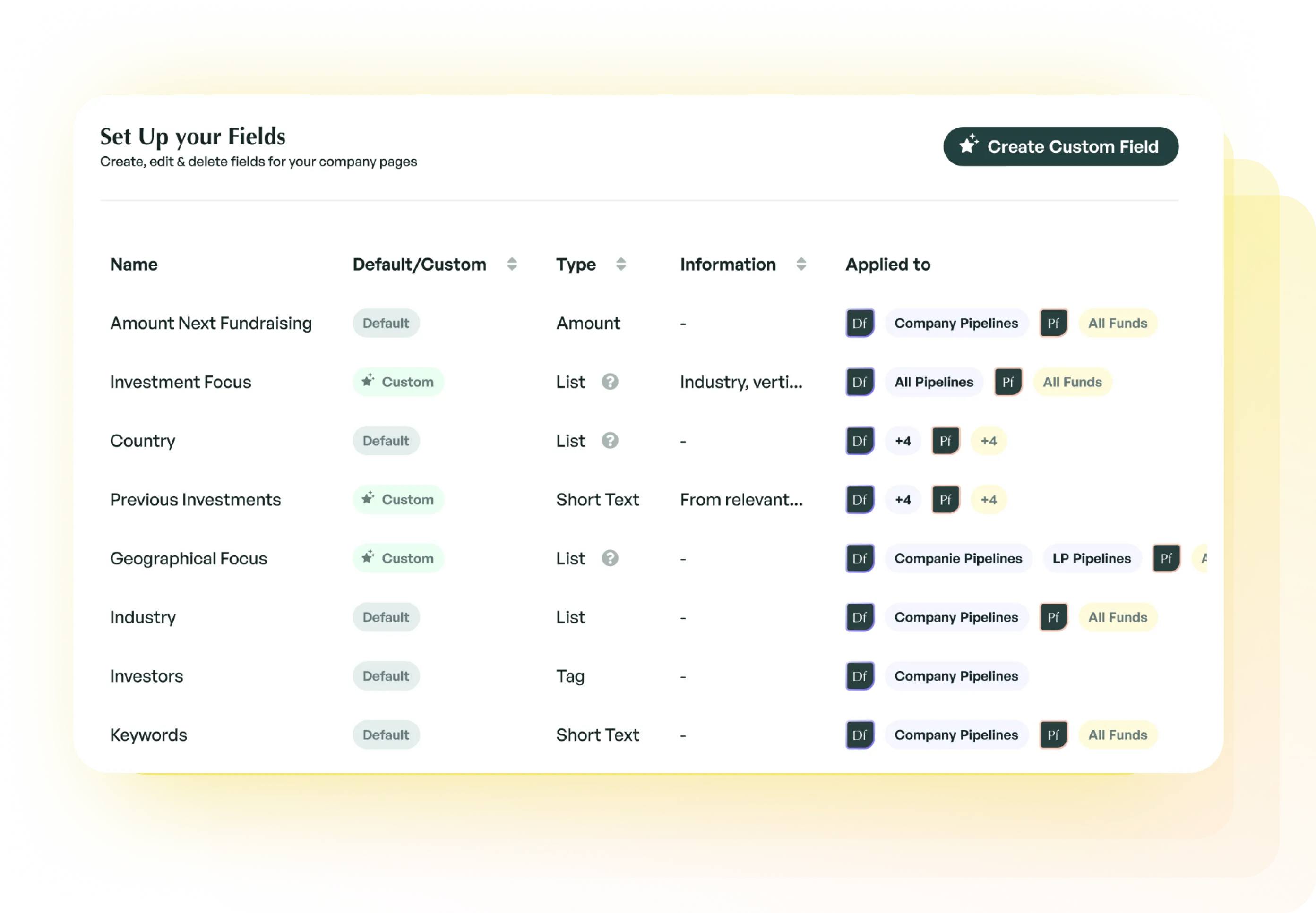
Tailor your contact management with what’s most important to your team. Custom fields are displayed with each contact, allowing you to keep the key details close.
Streamline Dealflow management
Tailor your contact management with what’s most important to your team. Custom fields are displayed with each contact, allowing you to keep the key details close.
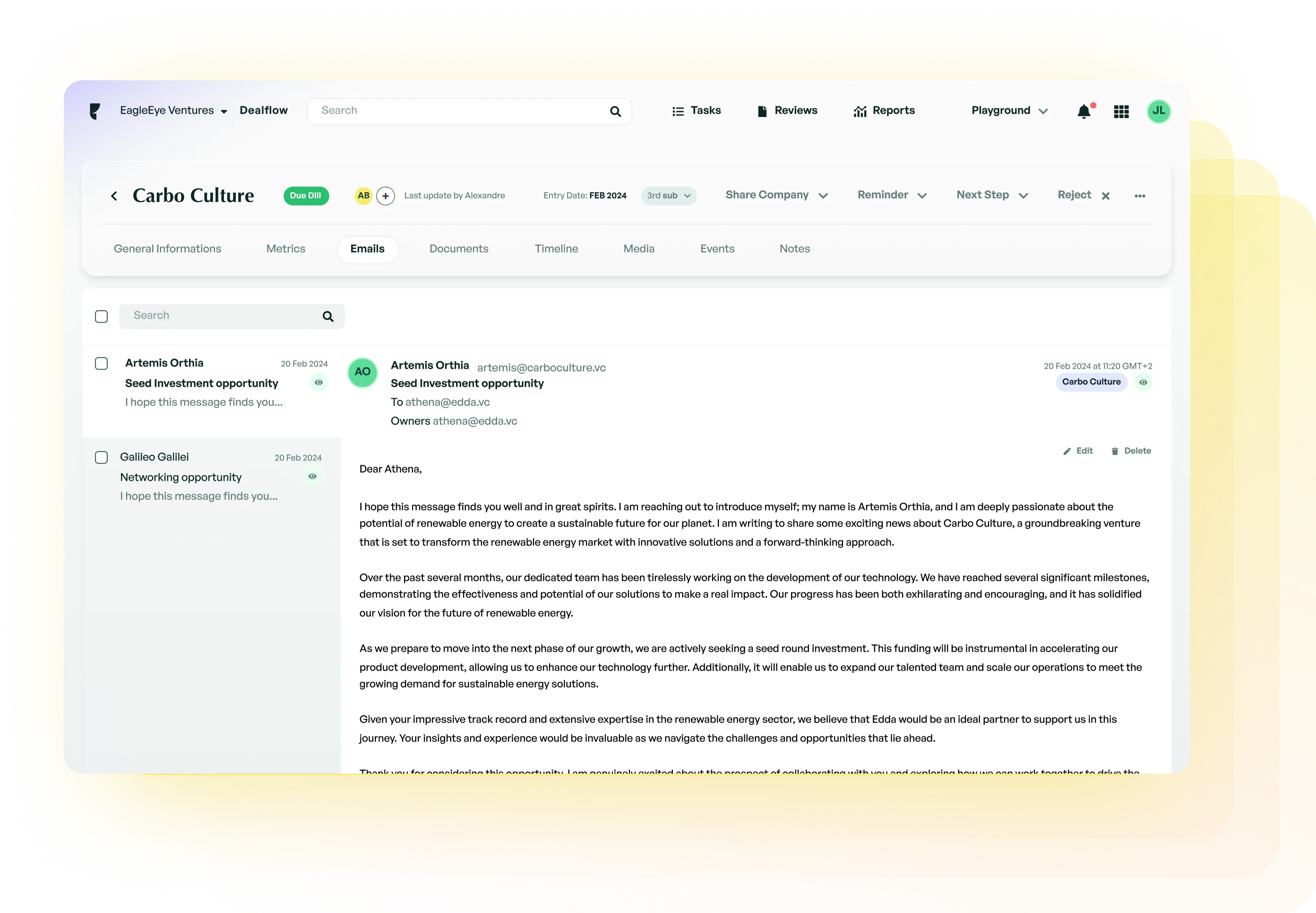
Enhance team collaboration
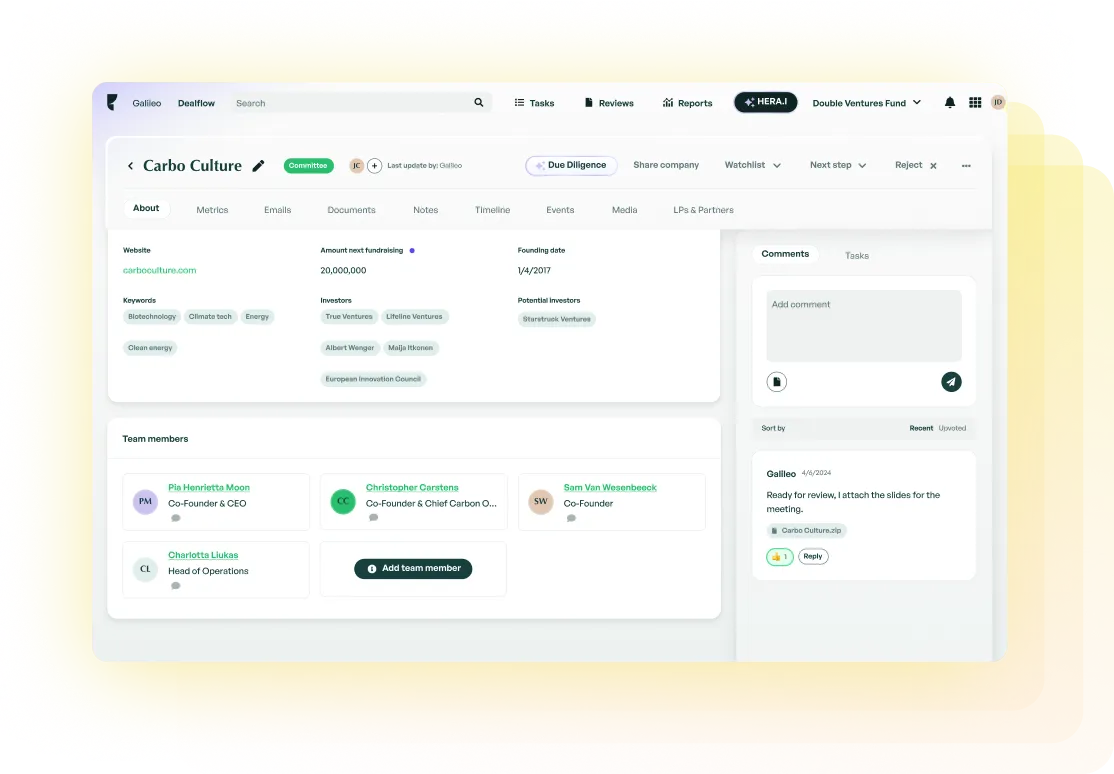
Share every interaction effortlessly and accelerate decision-making with up-to-date information. Keep everyone in the loop with streamlined communication.
What our users say about us
“We are truly happy with Edda and how the platform enables us to better monitor our performance and report to our stakeholders. Our Edda team also provides exceptional customer service and support, something we highly value.”

Lise Fulland
- Norway
“We are truly happy with Edda and how the platform enables us to better monitor our performance and report to our stakeholders. Our Edda team also provides exceptional customer service and support, something we highly value.”
Lise Fulland
- Norway
Interested?
Get started with 
Discover the power of specialized intelligence for your investments.
Discover more from Edda

HERA.I

Dealflow

Portfolio

Portal

Integrations
The Case for a Specialized CRM in Private Equity and Venture Capital
A general-purpose CRM like Attio or Salesforce may handle basic contact management, but it lacks the depth required for investment professionals. Private equity and venture capital firms operate in a relationship-driven ecosystem where every interaction—whether with founders, co-investors, or limited partners—carries strategic weight. A private equity CRM built for investors goes beyond storing names and emails. It maps networks, tracks deal participation, and surfaces warm introductions that generalist tools overlook.
Investment firms need more than a digital rolodex. They require a system that understands the lifecycle of a deal, from sourcing to exit, and connects every stakeholder to the right opportunity. This is where relationship intelligence becomes critical. Unlike generic CRMs, a venture capital CRM designed for investors integrates deal flow, portfolio tracking, and investor relations into a single platform, eliminating the need for disjointed spreadsheets or manual data entry.
Edda’s approach to CRM for investors addresses these gaps by embedding relationship intelligence directly into the workflow. The platform doesn’t just store contact details—it enriches them with contextual data, such as past investments, syndicate participation, and LP commitments, ensuring that every outreach is informed and strategic.
How Relationship Intelligence Transforms Investor Workflows
Relationship intelligence is more than a buzzword—it’s a functional layer that automates the tedious work of maintaining and leveraging an investor’s network. For private equity and venture capital firms, this means reducing the time spent on manual research while increasing the quality of connections. A deal flow CRM with relationship intelligence capabilities can, for example, flag when a contact has previously invested in a sector relevant to an active deal, or highlight shared connections who could facilitate a warm introduction.
Edda’s CRM module does this by integrating with its broader platform. When a deal moves from sourcing to due diligence, the system automatically links relevant contacts—founders, co-investors, or advisors—to the opportunity. This seamless connection between dealflow and relationship management ensures that no critical relationship is overlooked. For firms managing multiple funds or strategies, this level of integration is a game-changer, as it eliminates the need to cross-reference data across disparate tools.
Another key advantage is contact enrichment. Rather than relying on static data, Edda’s CRM dynamically updates contact profiles with information from public sources, such as funding rounds, board seats, or LP commitments. This ensures that investment teams always have the most current and relevant data at their fingertips, without the need for manual updates. For firms operating in fast-moving sectors like fintech or biotech, this real-time enrichment is essential for maintaining a competitive edge.
Why Generalist CRMs Fall Short for Investment Professionals
Generalist CRMs like Attio or Salesforce are designed for broad use cases, from sales teams to customer support. While they offer flexibility, they lack the specialized features that private equity and venture capital firms require. For example, a private equity CRM must track not just individual contacts but also their roles in specific deals, their LP commitments, and their historical participation in syndicates. Generalist tools force firms to build custom fields and workflows, which often leads to inefficiencies and data silos.
Edda’s CRM, by contrast, is purpose-built for investors. It understands the nuances of the investment lifecycle, from sourcing to portfolio management, and integrates these workflows into a single platform. This eliminates the need for firms to stitch together multiple tools, reducing operational friction and improving data accuracy. For example, when a deal is marked as "Invested" in Edda’s dealflow module, it automatically updates the CRM to reflect the new relationship dynamics, such as adding the founder to the portfolio tracking system.
Another limitation of generalist CRMs is their lack of integration with industry-specific data sources. Edda’s CRM connects to platforms like PitchBook, Crunchbase, and Dealroom, ensuring that contact enrichment is both automated and relevant to the investment context. This level of integration is critical for firms that rely on up-to-date market intelligence to inform their decisions.
The Role of AI in Enhancing Relationship Intelligence
Artificial intelligence is transforming how investment professionals manage their networks. Edda’s proprietary AI suite, HERA.I, includes modules that automate time-consuming tasks, such as parsing pitch decks or importing cap tables. For CRM workflows, HERA.I’s capabilities extend to relationship intelligence by analyzing patterns in communication, deal participation, and network connections to surface actionable insights.
For example, HERA.I can identify which contacts in a firm’s network are most likely to facilitate a warm introduction to a target founder, based on past interactions and shared connections. This reduces the guesswork in outreach and increases the likelihood of a positive response. Similarly, the AI can flag when a contact’s activity—such as a new board seat or a recent funding round—warrants a follow-up, ensuring that investment teams stay proactive in their relationship management.
HERA.I also enhances contact enrichment by pulling data from public sources and integrating it into the CRM. This ensures that profiles are always up-to-date, without requiring manual input from the team. For firms managing hundreds or thousands of contacts, this automation is a significant time-saver, allowing them to focus on high-value activities like deal sourcing and portfolio support.
Integrating CRM with the Broader Investment Workflow
A CRM is only as valuable as its ability to integrate with the rest of an investment firm’s workflow. Edda’s platform is designed to be end-to-end, meaning that data flows seamlessly between modules. For example, when a deal is sourced in the dealflow module, the CRM automatically links the relevant contacts—founders, co-investors, or advisors—to the opportunity. This ensures that relationship intelligence is always contextual and actionable.
For private equity and venture capital firms, this integration is particularly important for LP reporting. Edda’s portfolio module tracks holdings and performance, while the CRM maintains a record of LP interactions. This allows firms to provide transparent, data-driven updates to their investors, strengthening trust and alignment. The platform’s integrations with tools like Slack, Microsoft Teams, and Outlook further streamline communication, ensuring that teams can collaborate efficiently without leaving the system.
Edda’s approach to integration extends beyond its own platform. The system connects to a wide range of third-party tools, including PitchBook, Crunchbase, and Dealroom, as well as cloud storage services like Google Drive and Dropbox. This ensures that firms can leverage their existing data sources without disrupting their workflows. For corporate venture capital (CVC) teams, which often operate within larger organizations, these integrations are particularly valuable, as they allow for seamless collaboration across departments.
FAQ
How does Edda’s CRM differ from a generalist CRM like Attio?
Edda’s CRM is purpose-built for private equity and venture capital investors, whereas generalist CRMs like Attio are designed for broad use cases. Edda’s platform integrates relationship intelligence, deal flow tracking, and portfolio management into a single system, eliminating the need for firms to use multiple tools. This specialization ensures that investment professionals can manage their networks and deals more efficiently, with features like contact enrichment and warm introduction mapping that generalist CRMs lack.
For example, when a deal moves from sourcing to due diligence, Edda’s CRM automatically links the relevant contacts to the opportunity, ensuring that relationship intelligence is always contextual. Generalist CRMs require manual setup for these workflows, which can lead to inefficiencies and data silos.
What is relationship intelligence, and why is it important for investors?
Relationship intelligence refers to the ability to map, track, and leverage an investor’s network in a strategic way. For private equity and venture capital firms, this means understanding not just who a contact is, but also their role in past deals, their LP commitments, and their potential to facilitate introductions. Relationship intelligence is important because it reduces the time spent on manual research and increases the quality of connections, leading to more effective outreach and deal sourcing.
Edda’s CRM embeds relationship intelligence into its workflows by automating contact enrichment and surfacing warm introductions. For example, the system can flag when a contact has previously invested in a sector relevant to an active deal, or highlight shared connections who could facilitate a warm introduction. This level of automation is critical for firms managing large networks, as it ensures that no opportunity is overlooked.
How does HERA.I enhance CRM workflows?
HERA.I, Edda’s proprietary AI suite, enhances CRM workflows by automating time-consuming tasks and surfacing actionable insights. For example, HERA.I can analyze patterns in communication and deal participation to identify which contacts in a firm’s network are most likely to facilitate a warm introduction. This reduces the guesswork in outreach and increases the likelihood of a positive response.
HERA.I also automates contact enrichment by pulling data from public sources like PitchBook and Crunchbase, ensuring that profiles are always up-to-date. This eliminates the need for manual updates, saving firms significant time and effort. Additionally, HERA.I can flag when a contact’s activity—such as a new board seat or a recent funding round—warrants a follow-up, ensuring that investment teams stay proactive in their relationship management.
Can Edda’s CRM integrate with other tools we already use?
Yes, Edda’s CRM is designed to integrate with a wide range of third-party tools, including data providers like PitchBook, Crunchbase, and Dealroom, as well as communication platforms like Slack, Microsoft Teams, and Outlook. The platform also connects to cloud storage services like Google Drive and Dropbox, ensuring that firms can leverage their existing data sources without disrupting their workflows.
For firms using tools like integrations with Zapier or Typeform, Edda’s CRM can also connect to these platforms, allowing for seamless data flow between systems. This level of integration is particularly valuable for corporate venture capital (CVC) teams, which often operate within larger organizations and need to collaborate across departments.
Is Edda’s CRM suitable for corporate venture capital (CVC) teams?
Yes, Edda’s CRM is well-suited for corporate venture capital (CVC) teams, which often face unique challenges in managing relationships across both internal and external stakeholders. The platform’s integration capabilities are particularly valuable for CVC teams, as they allow for seamless collaboration with other departments, such as corporate development or R&D.
Edda’s CRM also supports the specific workflows of CVC teams, such as tracking strategic investments and aligning them with corporate objectives. The platform’s relationship intelligence features ensure that CVC teams can maintain strong connections with founders, co-investors, and LPs, while its integration with tools like Slack and Microsoft Teams facilitates efficient communication within the organization.
The Case for a Specialized CRM in Private Equity and Venture Capital
A general-purpose CRM like Attio or Salesforce may handle basic contact management, but it lacks the depth required for investment professionals. Private equity and venture capital firms operate in a relationship-driven ecosystem where every interaction—whether with founders, co-investors, or limited partners—carries strategic weight. A private equity CRM built for investors goes beyond storing names and emails. It maps networks, tracks deal participation, and surfaces warm introductions that generalist tools overlook.
Investment firms need more than a digital rolodex. They require a system that understands the lifecycle of a deal, from sourcing to exit, and connects every stakeholder to the right opportunity. This is where relationship intelligence becomes critical. Unlike generic CRMs, a venture capital CRM designed for investors integrates deal flow, portfolio tracking, and investor relations into a single platform, eliminating the need for disjointed spreadsheets or manual data entry.
Edda’s approach to CRM for investors addresses these gaps by embedding relationship intelligence directly into the workflow. The platform doesn’t just store contact details—it enriches them with contextual data, such as past investments, syndicate participation, and LP commitments, ensuring that every outreach is informed and strategic.
How Relationship Intelligence Transforms Investor Workflows
Relationship intelligence is more than a buzzword—it’s a functional layer that automates the tedious work of maintaining and leveraging an investor’s network. For private equity and venture capital firms, this means reducing the time spent on manual research while increasing the quality of connections. A deal flow CRM with relationship intelligence capabilities can, for example, flag when a contact has previously invested in a sector relevant to an active deal, or highlight shared connections who could facilitate a warm introduction.
Edda’s CRM module does this by integrating with its broader platform. When a deal moves from sourcing to due diligence, the system automatically links relevant contacts—founders, co-investors, or advisors—to the opportunity. This seamless connection between dealflow and relationship management ensures that no critical relationship is overlooked. For firms managing multiple funds or strategies, this level of integration is a game-changer, as it eliminates the need to cross-reference data across disparate tools.
Another key advantage is contact enrichment. Rather than relying on static data, Edda’s CRM dynamically updates contact profiles with information from public sources, such as funding rounds, board seats, or LP commitments. This ensures that investment teams always have the most current and relevant data at their fingertips, without the need for manual updates. For firms operating in fast-moving sectors like fintech or biotech, this real-time enrichment is essential for maintaining a competitive edge.
Why Generalist CRMs Fall Short for Investment Professionals
Generalist CRMs like Attio or Salesforce are designed for broad use cases, from sales teams to customer support. While they offer flexibility, they lack the specialized features that private equity and venture capital firms require. For example, a private equity CRM must track not just individual contacts but also their roles in specific deals, their LP commitments, and their historical participation in syndicates. Generalist tools force firms to build custom fields and workflows, which often leads to inefficiencies and data silos.
Edda’s CRM, by contrast, is purpose-built for investors. It understands the nuances of the investment lifecycle, from sourcing to portfolio management, and integrates these workflows into a single platform. This eliminates the need for firms to stitch together multiple tools, reducing operational friction and improving data accuracy. For example, when a deal is marked as "Invested" in Edda’s dealflow module, it automatically updates the CRM to reflect the new relationship dynamics, such as adding the founder to the portfolio tracking system.
Another limitation of generalist CRMs is their lack of integration with industry-specific data sources. Edda’s CRM connects to platforms like PitchBook, Crunchbase, and Dealroom, ensuring that contact enrichment is both automated and relevant to the investment context. This level of integration is critical for firms that rely on up-to-date market intelligence to inform their decisions.
The Role of AI in Enhancing Relationship Intelligence
Artificial intelligence is transforming how investment professionals manage their networks. Edda’s proprietary AI suite, HERA.I, includes modules that automate time-consuming tasks, such as parsing pitch decks or importing cap tables. For CRM workflows, HERA.I’s capabilities extend to relationship intelligence by analyzing patterns in communication, deal participation, and network connections to surface actionable insights.
For example, HERA.I can identify which contacts in a firm’s network are most likely to facilitate a warm introduction to a target founder, based on past interactions and shared connections. This reduces the guesswork in outreach and increases the likelihood of a positive response. Similarly, the AI can flag when a contact’s activity—such as a new board seat or a recent funding round—warrants a follow-up, ensuring that investment teams stay proactive in their relationship management.
HERA.I also enhances contact enrichment by pulling data from public sources and integrating it into the CRM. This ensures that profiles are always up-to-date, without requiring manual input from the team. For firms managing hundreds or thousands of contacts, this automation is a significant time-saver, allowing them to focus on high-value activities like deal sourcing and portfolio support.
Integrating CRM with the Broader Investment Workflow
A CRM is only as valuable as its ability to integrate with the rest of an investment firm’s workflow. Edda’s platform is designed to be end-to-end, meaning that data flows seamlessly between modules. For example, when a deal is sourced in the dealflow module, the CRM automatically links the relevant contacts—founders, co-investors, or advisors—to the opportunity. This ensures that relationship intelligence is always contextual and actionable.
For private equity and venture capital firms, this integration is particularly important for LP reporting. Edda’s portfolio module tracks holdings and performance, while the CRM maintains a record of LP interactions. This allows firms to provide transparent, data-driven updates to their investors, strengthening trust and alignment. The platform’s integrations with tools like Slack, Microsoft Teams, and Outlook further streamline communication, ensuring that teams can collaborate efficiently without leaving the system.
Edda’s approach to integration extends beyond its own platform. The system connects to a wide range of third-party tools, including PitchBook, Crunchbase, and Dealroom, as well as cloud storage services like Google Drive and Dropbox. This ensures that firms can leverage their existing data sources without disrupting their workflows. For corporate venture capital (CVC) teams, which often operate within larger organizations, these integrations are particularly valuable, as they allow for seamless collaboration across departments.
FAQ
How does Edda’s CRM differ from a generalist CRM like Attio?
Edda’s CRM is purpose-built for private equity and venture capital investors, whereas generalist CRMs like Attio are designed for broad use cases. Edda’s platform integrates relationship intelligence, deal flow tracking, and portfolio management into a single system, eliminating the need for firms to use multiple tools. This specialization ensures that investment professionals can manage their networks and deals more efficiently, with features like contact enrichment and warm introduction mapping that generalist CRMs lack.
For example, when a deal moves from sourcing to due diligence, Edda’s CRM automatically links the relevant contacts to the opportunity, ensuring that relationship intelligence is always contextual. Generalist CRMs require manual setup for these workflows, which can lead to inefficiencies and data silos.
What is relationship intelligence, and why is it important for investors?
Relationship intelligence refers to the ability to map, track, and leverage an investor’s network in a strategic way. For private equity and venture capital firms, this means understanding not just who a contact is, but also their role in past deals, their LP commitments, and their potential to facilitate introductions. Relationship intelligence is important because it reduces the time spent on manual research and increases the quality of connections, leading to more effective outreach and deal sourcing.
Edda’s CRM embeds relationship intelligence into its workflows by automating contact enrichment and surfacing warm introductions. For example, the system can flag when a contact has previously invested in a sector relevant to an active deal, or highlight shared connections who could facilitate a warm introduction. This level of automation is critical for firms managing large networks, as it ensures that no opportunity is overlooked.
How does HERA.I enhance CRM workflows?
HERA.I, Edda’s proprietary AI suite, enhances CRM workflows by automating time-consuming tasks and surfacing actionable insights. For example, HERA.I can analyze patterns in communication and deal participation to identify which contacts in a firm’s network are most likely to facilitate a warm introduction. This reduces the guesswork in outreach and increases the likelihood of a positive response.
HERA.I also automates contact enrichment by pulling data from public sources like PitchBook and Crunchbase, ensuring that profiles are always up-to-date. This eliminates the need for manual updates, saving firms significant time and effort. Additionally, HERA.I can flag when a contact’s activity—such as a new board seat or a recent funding round—warrants a follow-up, ensuring that investment teams stay proactive in their relationship management.
Can Edda’s CRM integrate with other tools we already use?
Yes, Edda’s CRM is designed to integrate with a wide range of third-party tools, including data providers like PitchBook, Crunchbase, and Dealroom, as well as communication platforms like Slack, Microsoft Teams, and Outlook. The platform also connects to cloud storage services like Google Drive and Dropbox, ensuring that firms can leverage their existing data sources without disrupting their workflows.
For firms using tools like integrations with Zapier or Typeform, Edda’s CRM can also connect to these platforms, allowing for seamless data flow between systems. This level of integration is particularly valuable for corporate venture capital (CVC) teams, which often operate within larger organizations and need to collaborate across departments.
Is Edda’s CRM suitable for corporate venture capital (CVC) teams?
Yes, Edda’s CRM is well-suited for corporate venture capital (CVC) teams, which often face unique challenges in managing relationships across both internal and external stakeholders. The platform’s integration capabilities are particularly valuable for CVC teams, as they allow for seamless collaboration with other departments, such as corporate development or R&D.
Edda’s CRM also supports the specific workflows of CVC teams, such as tracking strategic investments and aligning them with corporate objectives. The platform’s relationship intelligence features ensure that CVC teams can maintain strong connections with founders, co-investors, and LPs, while its integration with tools like Slack and Microsoft Teams facilitates efficient communication within the organization.