Edda or Attio?
Venturing away from one-size-fits-all solutions and into the realm of bespoke venture capital deal flow management software?
With Edda and Attio's platforms standing out as premier choices, you're undeniably steering towards contemporary efficacy.
In this guide, we’ll probe into an in-depth comparison between Edda and Attio, two dynamic CRM for venture capital systems, arming you with the knowledge needed to discern the software that dovetails flawlessly with your distinct customer relationship and business process imperatives.

First, Here’s an Overview of Edda and Attio Deal Flow CRM
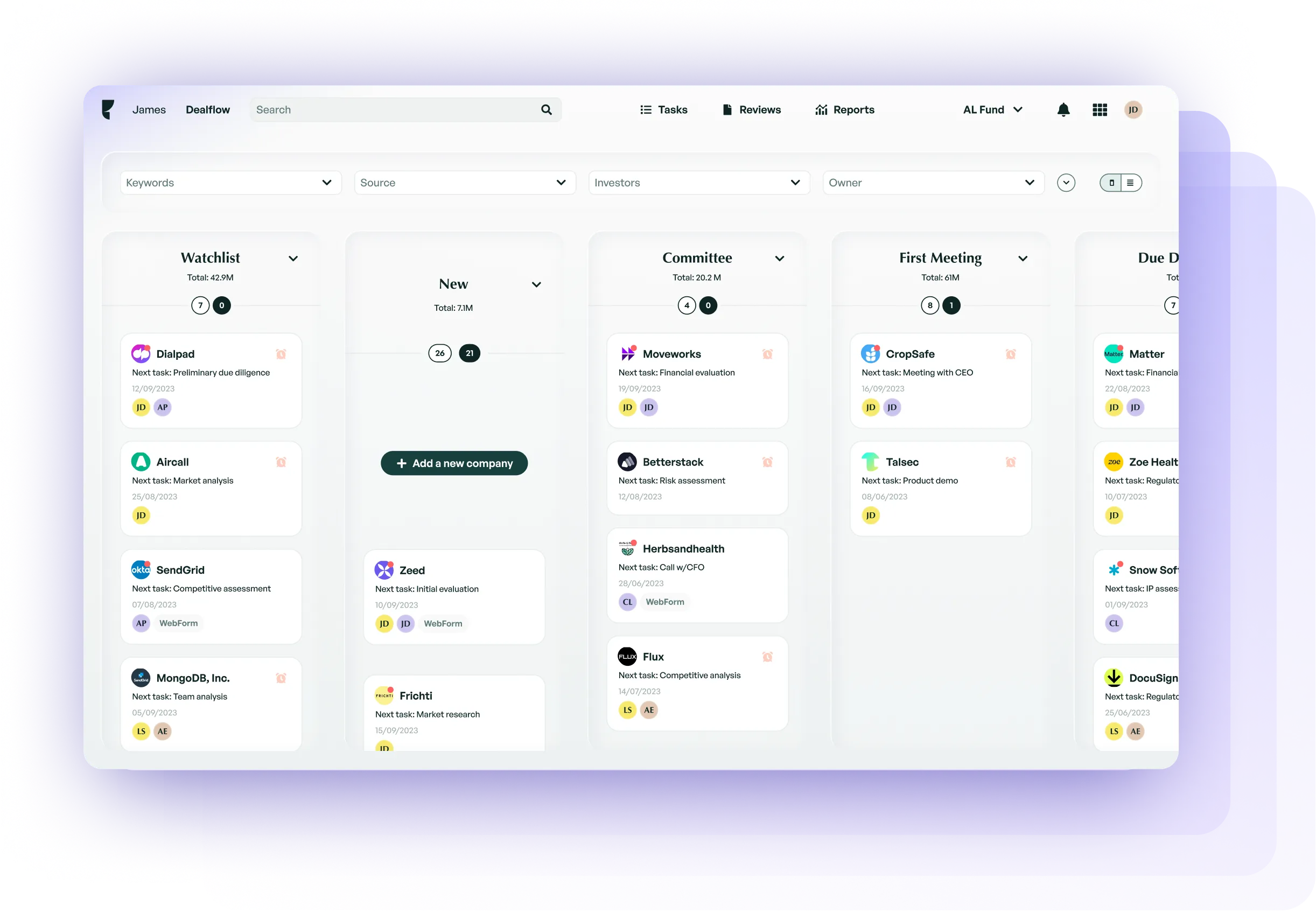
Edda CRM System
Edda's deal flow software seamlessly integrates comprehensive business processes and relationship management into a unified platform. This integration not only facilitates improved team management and deal oversight but also lays the foundation for great collaboration. Edda's core principle is that enhanced visibility throughout business processes cultivates stronger relationships, ultimately leading to better outcomes.
Edda positions itself as the singular deal flow management software, necessary for organizations. From venture capital sourcing and pipeline management to VC due diligence and portfolio supervision, Edda's CRM VC software both simplifies and enhances the way businesses engage and operate. Reflecting its holistic capabilities, the platform currently manages over $170 billion for preeminent private equity and VC firms spanning more than 40 countries. Beyond refining investment strategies, Edda's CRM platform also optimizes your daily workflows, increasing team efficiency.
Attio CRM System
On the other hand, Attio pulls all aspects of customer relationship management and business processes together, in one VC tech platform. This betters your team's ability to manage relationships and daily operations. Envisioned as the comprehensive CRM for private equity, Attio offers features ranging from real-time collaboration to powerful reporting tools, providing a dynamic system that adapts to your business's unique needs and workflows.
In terms of versatility, startups entrust Attio as the best CRM for their specific needs, while established enterprises rely on Attio for comprehensive CRM solutions. Beyond its role in facilitating customer relationship management, Attio also streamlines operations, promoting real-time collaboration and creating a more cohesive team environment.
When choosing CRM and deal flow software, understanding features and capabilities is paramount. It's essential to select a solution that encapsulates all the functionalities your team requires. With this in mind, let's look at the features of Edda and Attio side by side. Note: We'll explore each feature in detail in the subsequent section.
Edda and Attio Deal Software Features Side by Side
When choosing a CRM and deal flow software, understanding its features and capabilities is paramount. It's essential to select a solution that encapsulates all the functionalities your team requires.
With this in mind, let's juxtapose the features of Edda and Attio side by side. Note: We'll explore each feature in detail in the subsequent sections.
FEATURES
Edda Software
Attio Software
What our users say about us


"No more Excel, Edda allows me to easily follow a hundred investments and track all the necessary financial KPIs."
CHOOSING BETWEEN ATTIO AND EDDA FLOW SOFTWARE: WHAT'S BEST FOR YOU?
The outcomes you achieve with a CRM and VC portfolio management software significantly depend on its features. It's crucial to select a tool that aligns with your firm's specific needs, organizational setup, operational methodologies, and investment philosophies. Bearing this in mind, let's explore the distinctive functionalities that set Edda apart from Attio.

CRM Platform
Edda is for you if...:
Choose Edda if you want a CRM system seamlessly integrating with the investment landscape. Edda's refined deal flow architecture offers a powerful and user-friendly CRM designed for private equity, providing simplified relationship management.
It integrates essential CRM functionalities including data acquisition, contact oversight, and seamless in-app interactions, reducing reliance on long-winded email exchanges.
Attio is for you if...:
Opt for Attio if you're looking for a truly customizable CRM solution that adapts to your business needs.
You're on the hunt for a CRM solution that's truly customizable, ensuring that the software adapts to your business needs rather than the other way around.

Dealflow Management
Edda is for you if...:
Choose Edda for a comprehensive view of your deal lifecycle, from initiation to conclusion, all within a single system
Edda's venture capital software provides insight into your entire deal pipeline, streamlining collaboration with teammates and companies for heightened productivity.
Attio is for you if...:
Opt for Attio if you need a uniquely tailored CRM platform with a focus on flexibility.
Attio offers complete customization, an intuitive interface, and dealflow management, promoting collaboration and real-time tracking.

Relationship Intelligence
Edda is for you if...:
Choose Edda if you aim to easily navigate and interpret intricate connections, unveiling latent opportunities and consolidating your entire business network.
Edda's system provides a clearer understanding of relationships between entities like firms, LPs, and partners, enabling you to bridge contacts effortlessly and discover new avenues for capital ventures and introductions.
Attio is for you if...:
Opt for Attio if you prioritize a CRM solution offering a deeply customizable experience tailored to your specific needs while capturing every interaction with your contacts.
With a focus on flexibility, Attio ensures meticulous tracking of every interaction and relationship, emphasizing data as the key to fostering stronger connections and enabling data-driven strategies.

Dealmaking Insights & Updates
Edda is for you if...:
Choose Edda if you're seeking an analytics-driven approach to enhance your investment outcomes and yield returns. With Edda, you gain a panoramic view of essential insights and updates designed to augment investment returns.
The platform excels in promptly appraising company and fund IRR, customizing reports for critical intelligence, and swiftly computing pivotal metrics such as NAV, DPI, TVPI, and beyond.
Attio is for you if...:
Opt for Attio if you prioritize a tool emphasizing workflow automations and integrations to streamline deal-making.
Attio excels in offering workflow automations, reducing manual input for your team to focus more on the deal itself. With integration capabilities, Attio seamlessly combines various data sources, ensuring a comprehensive view of your deals and the necessary insights at your fingertips.

Portfolio Management
Edda is for you if...:
Choose Edda if you desire seamless integration of comprehensive asset oversight into your deal software.
Edda offers superior VC portfolio management, simplifying and amplifying every facet, from delving into vital metrics and real-time updates from portfolio companies to engaging seamlessly with entrepreneurs and conducting relative value analyses.
Attio is for you if...:
Opt for Attio if workflow automations and seamless integrations top your list for optimizing portfolio management.
Attio's robust emphasis on workflow automations streamlines processes, cutting down on manual efforts and inefficiencies. With integration capabilities, Attio brings in data and insights from various sources, ensuring a holistic understanding of your portfolio and facilitating informed decision-making.

Workflow Automations
Edda is for you if...:
Choose Edda if you want to enhance the efficiency of your internal processes and automate repetitive aspects of investment management.
Edda streamlines deal and private equity portfolio monitoring complexities with intuitive tools and automations. It ensures staying ahead of updates, effortless collaboration with stakeholders, and seamless evaluation of potential investments, automating the entire investment process for time savings and reduced errors.
Attio is for you if...:
Opt for Attio if your focus is on real-time collaboration and adaptive automation tailored to diverse business needs
Attio excels in facilitating interactive and adaptive workflow automations with customizable blocks and templates. This dynamic approach not only enhances efficiency but also keeps your team on the same page, even when working on diverse tasks.

Accelerated Due Diligence
Edda is for you if...:
Choose Edda if your goal is to have an automated processes for quick and accurate decisions.
Edda simplifies the due diligence process in private equity and venture capital by providing instant access to company metrics, industry-related data, and comprehensive reviews of founders and their teams, enabling more efficient assessment of a broader range of deals.
Attio is for you if...:
Opt for Attio if you're seeking a CRM emphasizing flexibility, customization, and real-time collaboration to enhance the due diligence process
Attio's powerful and adaptable CRM features provide a robust foundation for thorough due diligence activities, allowing teams to tailor the platform to specific business needs. Its data-driven capabilities ensure enriched, up-to-date information, potentially elevating due diligence

LP Portal
Edda is for you if...:
Choose Edda if you aim for increased transparency and simplified interactions with partners by providing direct access to crucial information.
Edda's LP Portal acts as a central gateway for external deal flow coordination, offering unmatched visibility, strengthened monitoring, simplified report generation, and centralized communication and document sharing in one cohesive space.
Attio is for you if...:
Opt for Attio if you value flexibility, customization, and data-driven insights for enhanced stakeholder engagement and communication.
While lacking a dedicated LP Portal like Edda, Attio's powerful CRM platform ensures stakeholders are well-informed with enriched data, custom attributes, and integrations. Emphasizing real-time collaboration and the ability to mold the platform to business needs, Attio facilitates streamlined investor interactions, focusing on relationship management for transparency and efficiency in stakeholder communication.

Edda vs Attio VC App Pricing Comparison
Naturally, when it comes to private equity deal tracking software, price is a consideration. And the cost of your private equity deal flow software must be weighed against the features it provides. The cost of Edda and the Attio CRM cost are customized depending on your team’s size and needs. Given this, it’s not possible to go into detail about Edda and Affinity CRM pricing in this article. This can be attained by requesting a demo of Edda or Attio.
When exploring CRM solutions, consider the following: Are you seeking a comprehensive solution like Edda that seamlessly integrates CRM functionalities with extensive business processes? A system that spans deal origination, pipeline management, and provides a unified platform for relationship management and due diligence? On the other hand, does Attio, with its strong foundation in adaptability and real-time collaboration, align more closely with your needs? A software that goes beyond the traditional CRM, offering ultra-customization and fostering a dynamic relationship with data and workflow management? If you're looking for a CRM system that not only centralizes business processes but also enhances relationship management, Edda emerges as a top choice. Beyond its CRM capabilities, Edda features a range of adeptly designed features to streamline deal progressions, strengthen pipelines, and enrich relationship intelligence.
Interested? Get started with
Discover the power of specialized intelligence for your investments.
Understanding the Core Use Cases: VC/PE Firms vs. General Businesses
Investment firms operate in a specialized ecosystem where relationships, deal flow, and portfolio management are deeply interconnected. A general-purpose CRM like Attio is designed for broad business applications, from sales pipelines to customer support. While it offers flexibility, it lacks the vertical-specific workflows that venture capital (VC) and private equity (PE) firms require. Edda, by contrast, is built exclusively for investment professionals, integrating deal sourcing, portfolio tracking, investor relations, and LP reporting into a single platform.
For VC and PE firms, the distinction is critical. A general CRM may handle contact management, but it cannot automatically transition a deal from sourcing to portfolio once an investment is made. Edda’s end-to-end architecture ensures that a deal marked as "Invested" in the dealflow module seamlessly appears in the portfolio module, eliminating manual data entry and reducing operational friction. This level of integration is absent in tools not purpose-built for investment workflows.
Feature Comparison: Where Edda and Attio Diverge
Dealflow Management: Attio’s pipeline tools are robust for sales teams but lack the depth needed for VC/PE deal sourcing. It does not natively support cap table imports, pitch deck analysis, or due diligence automation—features that Edda’s HERA.I suite provides. HERA.I’s Pitch Deck Reader, for example, extracts key metrics from decks and populates them directly into deal records, a capability Attio does not offer.
Portfolio Tracking and LP Reporting: Edda’s portfolio module is designed for investment firms managing multiple funds, with built-in LP reporting templates and performance dashboards. Attio, as a general CRM, does not include portfolio monitoring or fund-level analytics. Firms using Attio for portfolio tracking must rely on third-party integrations or manual spreadsheets, introducing inefficiencies and data silos.
CRM and Investor Network: Both platforms support contact management, but Edda’s CRM is tailored for investor relations. It tracks LP commitments, fund distributions, and partner communications within the same system used for deal flow. Attio’s CRM, while customizable, requires additional configuration to replicate this functionality, and even then, it lacks the investment-specific fields and workflows that Edda includes by default.
Collaboration and Portal: Edda’s Portal module enables secure collaboration between GPs, LPs, and portfolio companies, with role-based access controls and document sharing. Attio offers team collaboration features, but they are not designed for the confidentiality and compliance requirements of VC/PE firms. The Portal also integrates with tools like Slack and Microsoft Teams, whereas Attio’s integrations are more generic.
Pricing: Transparency and Value for Investment Firms
Neither Edda nor Attio publishes its pricing publicly, but the value proposition for VC/PE firms differs significantly. Attio’s pricing is structured for general business use, with plans based on user count and feature tiers. For investment firms, this can lead to unpredictable costs as teams scale or require additional modules. Edda’s pricing, while also not public, is tailored to the needs of VC, PE, and corporate venture capital (CVC) firms, with plans that align with firm size and workflow complexity.
Edda offers four plans—First-Time GP, Premium, Pro, and Enterprise—each designed to accommodate the specific needs of investment firms at different stages of growth. The lack of public pricing reflects the custom nature of these plans, which are typically negotiated based on a firm’s assets under management (AUM), team size, and required integrations. Attio’s pricing, while flexible, does not account for the unique demands of investment workflows, such as portfolio tracking or LP reporting, which may require additional third-party tools.
For firms evaluating both platforms, the decision often comes down to whether they prioritize a general-purpose CRM with broad customization or a specialized platform built for investment professionals. Edda’s focus on VC/PE workflows means that firms avoid the cost and complexity of integrating multiple tools to replicate its functionality.
AI Capabilities: HERA.I vs. Attio’s General AI Features
Attio has introduced AI features to enhance its CRM, such as automated contact enrichment and email drafting. However, these tools are designed for general business use and lack the investment-specific capabilities of Edda’s HERA.I suite. HERA.I includes four concrete modules that address the unique needs of VC/PE firms:
Pitch Deck Reader: Automatically extracts key data from pitch decks, such as founder backgrounds, market size, and financial projections, and populates it into deal records. This reduces manual data entry and accelerates deal evaluation.
Cap Table Importer: Simplifies the onboarding of portfolio companies by importing cap table data directly into Edda, ensuring accuracy and consistency across deal records.
Due Diligence Assistant: Generates due diligence checklists and synthesizes research from multiple sources, helping firms streamline the evaluation process.
Decision Writer: Automates the creation of rejection letters, saving time while maintaining professionalism and consistency in communications.
Attio’s AI features, while useful for general CRM tasks, do not offer the same level of specialization for investment workflows. For firms that rely on AI to enhance efficiency and decision-making, HERA.I provides a clear advantage.
Integration Ecosystem: How Each Platform Fits Into a Firm’s Tech Stack
Both Edda and Attio offer integrations with popular business tools, but their ecosystems serve different purposes. Attio integrates with general business applications like Slack, Google Workspace, and Zapier, which are useful for a wide range of industries. However, it lacks native integrations with tools specific to VC/PE, such as PitchBook, Crunchbase, or Dealroom, which are critical for deal sourcing and market intelligence.
Edda’s integration ecosystem is designed for investment firms, with direct connections to industry-specific tools like PitchBook, Crunchbase, and Dealroom. It also integrates with communication platforms like Slack, Microsoft Teams, Outlook, and Gmail, as well as file storage services like Google Drive and Dropbox. These integrations ensure that data flows seamlessly between systems, reducing manual work and minimizing errors.
For firms that rely on Salesforce, it’s worth noting that neither Edda nor Attio prioritizes this integration. Edda’s focus is on tools that enhance investment workflows, while Attio’s integrations are more general. Firms using Salesforce may need to evaluate whether either platform can fully replace or complement their existing setup.
FAQ
What are the key differences between Edda and Attio for VC firms?
The primary difference lies in specialization. Edda is built exclusively for VC, PE, and corporate venture capital firms, with features like dealflow management, portfolio tracking, LP reporting, and HERA.I’s investment-specific AI tools. Attio, as a general-purpose CRM, offers flexibility but lacks the vertical-specific workflows that investment firms require. For example, Edda automatically transitions a deal from sourcing to portfolio once it’s marked as "Invested," a capability that Attio does not provide without significant customization.
Additionally, Edda’s integration ecosystem includes tools like PitchBook and Crunchbase, which are essential for deal sourcing, while Attio’s integrations are more generic. For firms that need a platform tailored to their industry, Edda offers a more streamlined and efficient solution.
How does Edda’s pricing compare to Attio’s for investment firms?
Neither Edda nor Attio publishes its pricing publicly, but the value proposition differs based on the needs of investment firms. Attio’s pricing is structured for general business use, with plans based on user count and feature tiers. For VC/PE firms, this can result in higher costs as they scale or require additional modules, such as portfolio tracking or LP reporting, which may not be included in Attio’s base plans.
Edda’s pricing is tailored to the needs of investment firms, with four plans (First-Time GP, Premium, Pro, and Enterprise) designed to accommodate firms of different sizes and complexities. While the lack of public pricing may seem like a drawback, it reflects the custom nature of these plans, which are negotiated based on a firm’s AUM, team size, and required integrations. For firms that prioritize a platform built for their industry, Edda’s pricing model is often more cost-effective in the long run.
What are the best Attio alternatives for VC and PE firms?
For VC and PE firms evaluating alternatives to Attio, the best options depend on their specific needs. Edda is a strong choice for firms that require an end-to-end platform with dealflow, portfolio tracking, LP reporting, and HERA.I’s AI capabilities. Other alternatives include:
Affinity: A CRM designed specifically for VC firms, with relationship intelligence and deal tracking. However, it lacks portfolio management and LP reporting features.
DealCloud (Intapp): A deal CRM built for enterprise PE and VC firms, with robust pipeline management but a steeper learning curve.
Visible.vc: A portfolio monitoring and LP reporting tool, though it also serves founders, which may not align with the needs of investment professionals.
Chronograph: Another portfolio monitoring tool, but it does not offer the same level of integration with dealflow or CRM as Edda.
For firms that need a platform tailored to their industry, Edda’s combination of dealflow, portfolio, CRM, and Portal modules makes it a comprehensive alternative to Attio.
Does Attio offer features for portfolio management and LP reporting?
Attio does not include native portfolio management or LP reporting features. As a general-purpose CRM, it is designed for contact management, sales pipelines, and team collaboration. Firms using Attio for portfolio tracking or LP reporting would need to rely on third-party integrations or manual processes, such as spreadsheets, to fill these gaps.
Edda, by contrast, includes a dedicated portfolio module for tracking holdings, performance, and fund-level analytics, as well as LP reporting templates. This ensures that firms can manage their investments and communicate with LPs within the same platform they use for dealflow and CRM. For investment firms, this level of integration is critical for efficiency and accuracy.
How does HERA.I compare to Attio’s AI features for investment workflows?
HERA.I is Edda’s proprietary AI suite, designed specifically for VC and PE workflows. It includes four concrete modules: Pitch Deck Reader, Cap Table Importer, Due Diligence Assistant, and Decision Writer. These tools automate time-consuming tasks like data extraction from pitch decks, cap table imports, due diligence research, and rejection letter drafting, all of which are unique to investment firms.
Attio’s AI features, while useful for general CRM tasks, are not tailored to the needs of VC/PE firms. For example, Attio’s AI can automate contact enrichment and email drafting, but it cannot extract key metrics from pitch decks or generate due diligence checklists. For firms that rely on AI to enhance their investment workflows, HERA.I provides a clear advantage over Attio’s general-purpose AI tools.
Understanding the Core Use Cases: VC/PE Firms vs. General Businesses
Investment firms operate in a specialized ecosystem where relationships, deal flow, and portfolio management are deeply interconnected. A general-purpose CRM like Attio is designed for broad business applications, from sales pipelines to customer support. While it offers flexibility, it lacks the vertical-specific workflows that venture capital (VC) and private equity (PE) firms require. Edda, by contrast, is built exclusively for investment professionals, integrating deal sourcing, portfolio tracking, investor relations, and LP reporting into a single platform.
For VC and PE firms, the distinction is critical. A general CRM may handle contact management, but it cannot automatically transition a deal from sourcing to portfolio once an investment is made. Edda’s end-to-end architecture ensures that a deal marked as "Invested" in the dealflow module seamlessly appears in the portfolio module, eliminating manual data entry and reducing operational friction. This level of integration is absent in tools not purpose-built for investment workflows.
Feature Comparison: Where Edda and Attio Diverge
Dealflow Management: Attio’s pipeline tools are robust for sales teams but lack the depth needed for VC/PE deal sourcing. It does not natively support cap table imports, pitch deck analysis, or due diligence automation—features that Edda’s HERA.I suite provides. HERA.I’s Pitch Deck Reader, for example, extracts key metrics from decks and populates them directly into deal records, a capability Attio does not offer.
Portfolio Tracking and LP Reporting: Edda’s portfolio module is designed for investment firms managing multiple funds, with built-in LP reporting templates and performance dashboards. Attio, as a general CRM, does not include portfolio monitoring or fund-level analytics. Firms using Attio for portfolio tracking must rely on third-party integrations or manual spreadsheets, introducing inefficiencies and data silos.
CRM and Investor Network: Both platforms support contact management, but Edda’s CRM is tailored for investor relations. It tracks LP commitments, fund distributions, and partner communications within the same system used for deal flow. Attio’s CRM, while customizable, requires additional configuration to replicate this functionality, and even then, it lacks the investment-specific fields and workflows that Edda includes by default.
Collaboration and Portal: Edda’s Portal module enables secure collaboration between GPs, LPs, and portfolio companies, with role-based access controls and document sharing. Attio offers team collaboration features, but they are not designed for the confidentiality and compliance requirements of VC/PE firms. The Portal also integrates with tools like Slack and Microsoft Teams, whereas Attio’s integrations are more generic.
Pricing: Transparency and Value for Investment Firms
Neither Edda nor Attio publishes its pricing publicly, but the value proposition for VC/PE firms differs significantly. Attio’s pricing is structured for general business use, with plans based on user count and feature tiers. For investment firms, this can lead to unpredictable costs as teams scale or require additional modules. Edda’s pricing, while also not public, is tailored to the needs of VC, PE, and corporate venture capital (CVC) firms, with plans that align with firm size and workflow complexity.
Edda offers four plans—First-Time GP, Premium, Pro, and Enterprise—each designed to accommodate the specific needs of investment firms at different stages of growth. The lack of public pricing reflects the custom nature of these plans, which are typically negotiated based on a firm’s assets under management (AUM), team size, and required integrations. Attio’s pricing, while flexible, does not account for the unique demands of investment workflows, such as portfolio tracking or LP reporting, which may require additional third-party tools.
For firms evaluating both platforms, the decision often comes down to whether they prioritize a general-purpose CRM with broad customization or a specialized platform built for investment professionals. Edda’s focus on VC/PE workflows means that firms avoid the cost and complexity of integrating multiple tools to replicate its functionality.
AI Capabilities: HERA.I vs. Attio’s General AI Features
Attio has introduced AI features to enhance its CRM, such as automated contact enrichment and email drafting. However, these tools are designed for general business use and lack the investment-specific capabilities of Edda’s HERA.I suite. HERA.I includes four concrete modules that address the unique needs of VC/PE firms:
Pitch Deck Reader: Automatically extracts key data from pitch decks, such as founder backgrounds, market size, and financial projections, and populates it into deal records. This reduces manual data entry and accelerates deal evaluation.
Cap Table Importer: Simplifies the onboarding of portfolio companies by importing cap table data directly into Edda, ensuring accuracy and consistency across deal records.
Due Diligence Assistant: Generates due diligence checklists and synthesizes research from multiple sources, helping firms streamline the evaluation process.
Decision Writer: Automates the creation of rejection letters, saving time while maintaining professionalism and consistency in communications.
Attio’s AI features, while useful for general CRM tasks, do not offer the same level of specialization for investment workflows. For firms that rely on AI to enhance efficiency and decision-making, HERA.I provides a clear advantage.
Integration Ecosystem: How Each Platform Fits Into a Firm’s Tech Stack
Both Edda and Attio offer integrations with popular business tools, but their ecosystems serve different purposes. Attio integrates with general business applications like Slack, Google Workspace, and Zapier, which are useful for a wide range of industries. However, it lacks native integrations with tools specific to VC/PE, such as PitchBook, Crunchbase, or Dealroom, which are critical for deal sourcing and market intelligence.
Edda’s integration ecosystem is designed for investment firms, with direct connections to industry-specific tools like PitchBook, Crunchbase, and Dealroom. It also integrates with communication platforms like Slack, Microsoft Teams, Outlook, and Gmail, as well as file storage services like Google Drive and Dropbox. These integrations ensure that data flows seamlessly between systems, reducing manual work and minimizing errors.
For firms that rely on Salesforce, it’s worth noting that neither Edda nor Attio prioritizes this integration. Edda’s focus is on tools that enhance investment workflows, while Attio’s integrations are more general. Firms using Salesforce may need to evaluate whether either platform can fully replace or complement their existing setup.
FAQ
What are the key differences between Edda and Attio for VC firms?
The primary difference lies in specialization. Edda is built exclusively for VC, PE, and corporate venture capital firms, with features like dealflow management, portfolio tracking, LP reporting, and HERA.I’s investment-specific AI tools. Attio, as a general-purpose CRM, offers flexibility but lacks the vertical-specific workflows that investment firms require. For example, Edda automatically transitions a deal from sourcing to portfolio once it’s marked as "Invested," a capability that Attio does not provide without significant customization.
Additionally, Edda’s integration ecosystem includes tools like PitchBook and Crunchbase, which are essential for deal sourcing, while Attio’s integrations are more generic. For firms that need a platform tailored to their industry, Edda offers a more streamlined and efficient solution.
How does Edda’s pricing compare to Attio’s for investment firms?
Neither Edda nor Attio publishes its pricing publicly, but the value proposition differs based on the needs of investment firms. Attio’s pricing is structured for general business use, with plans based on user count and feature tiers. For VC/PE firms, this can result in higher costs as they scale or require additional modules, such as portfolio tracking or LP reporting, which may not be included in Attio’s base plans.
Edda’s pricing is tailored to the needs of investment firms, with four plans (First-Time GP, Premium, Pro, and Enterprise) designed to accommodate firms of different sizes and complexities. While the lack of public pricing may seem like a drawback, it reflects the custom nature of these plans, which are negotiated based on a firm’s AUM, team size, and required integrations. For firms that prioritize a platform built for their industry, Edda’s pricing model is often more cost-effective in the long run.
What are the best Attio alternatives for VC and PE firms?
For VC and PE firms evaluating alternatives to Attio, the best options depend on their specific needs. Edda is a strong choice for firms that require an end-to-end platform with dealflow, portfolio tracking, LP reporting, and HERA.I’s AI capabilities. Other alternatives include:
Affinity: A CRM designed specifically for VC firms, with relationship intelligence and deal tracking. However, it lacks portfolio management and LP reporting features.
DealCloud (Intapp): A deal CRM built for enterprise PE and VC firms, with robust pipeline management but a steeper learning curve.
Visible.vc: A portfolio monitoring and LP reporting tool, though it also serves founders, which may not align with the needs of investment professionals.
Chronograph: Another portfolio monitoring tool, but it does not offer the same level of integration with dealflow or CRM as Edda.
For firms that need a platform tailored to their industry, Edda’s combination of dealflow, portfolio, CRM, and Portal modules makes it a comprehensive alternative to Attio.
Does Attio offer features for portfolio management and LP reporting?
Attio does not include native portfolio management or LP reporting features. As a general-purpose CRM, it is designed for contact management, sales pipelines, and team collaboration. Firms using Attio for portfolio tracking or LP reporting would need to rely on third-party integrations or manual processes, such as spreadsheets, to fill these gaps.
Edda, by contrast, includes a dedicated portfolio module for tracking holdings, performance, and fund-level analytics, as well as LP reporting templates. This ensures that firms can manage their investments and communicate with LPs within the same platform they use for dealflow and CRM. For investment firms, this level of integration is critical for efficiency and accuracy.
How does HERA.I compare to Attio’s AI features for investment workflows?
HERA.I is Edda’s proprietary AI suite, designed specifically for VC and PE workflows. It includes four concrete modules: Pitch Deck Reader, Cap Table Importer, Due Diligence Assistant, and Decision Writer. These tools automate time-consuming tasks like data extraction from pitch decks, cap table imports, due diligence research, and rejection letter drafting, all of which are unique to investment firms.
Attio’s AI features, while useful for general CRM tasks, are not tailored to the needs of VC/PE firms. For example, Attio’s AI can automate contact enrichment and email drafting, but it cannot extract key metrics from pitch decks or generate due diligence checklists. For firms that rely on AI to enhance their investment workflows, HERA.I provides a clear advantage over Attio’s general-purpose AI tools.